The Churchill Casebook of Curiosities
Book Four: The Mysterious Case of the Severed Hand
Interlude: Translation Notes on the Kebra Nagast
The Ark of the Covenant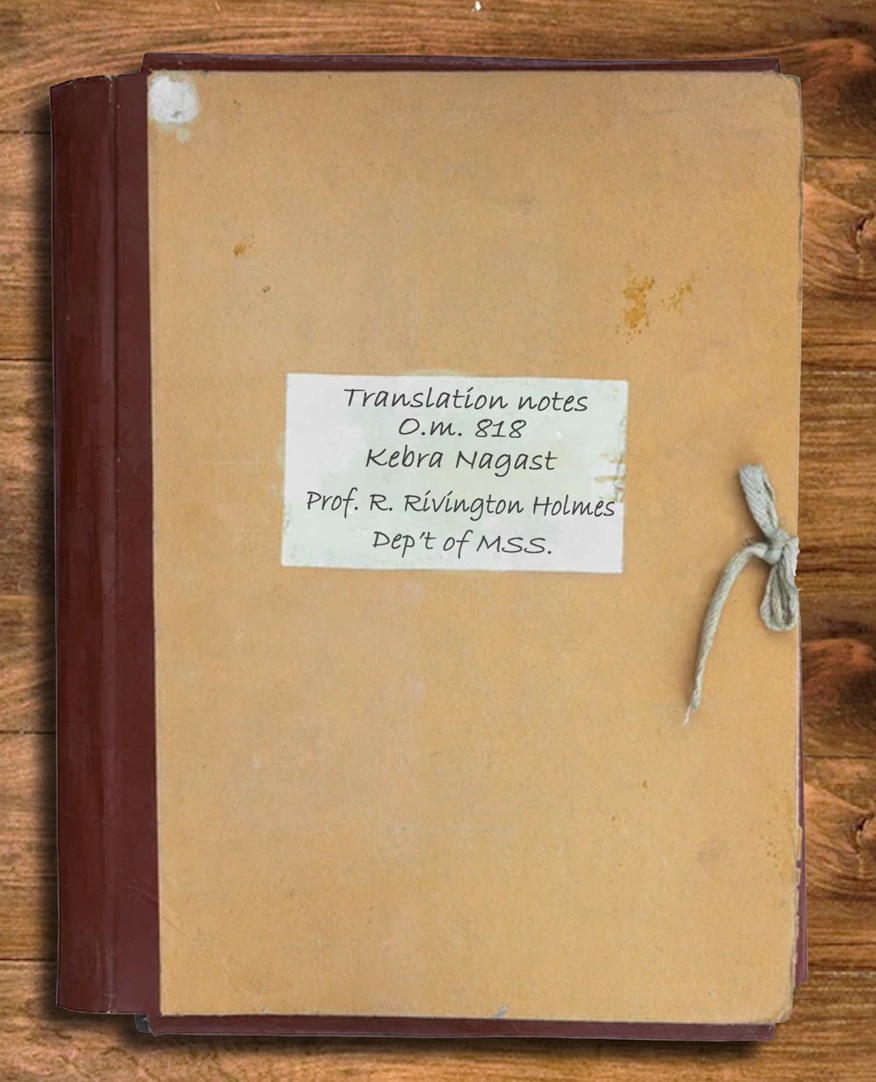
Translation notes
O.M. 818
Kebra Nagast
Prof. R. Rivington Holmes
Dep’t of M.S.S.
A partial summary of the text of the Kebra Nagast as we thus far understand it. Compiled from the earlier works of Prof. Dillmann and from descriptive accounts given to me in person by clergy of the Abyssinian church together with the translation efforts of myself and colleagues at the British Museum in our study of Oriental Manuscripts 818 and 819.
The Kebra Nagast—‘Glory of Kings’—is divided into 118 chapters, and is presented in the form of a debate by the 318 “orthodox fathers” of the First Council of Nicaea. It can broadly be divided into three parts.
Opening (Chapters 1-20)
The fathers pose the question, “Of what doth the Glory of Kings consist?” There is much debate before the archbishop Dĕmâtĕyôs takes the floor and reads from a book he claims to have found in the church of “Sophia”, this is the story of Makeda - the Queen of Sheba, King Solomon and Menelik.
The Queen of Sheba and Menelik (Chapters 21-96)
Queen Makeda learns from Tamrin, a merchant based in her kingdom, about the wisdom of King Solomon, and travels to Jerusalem to visit him. She is enthralled by his display of learning and knowledge, and declares “From this moment I will not worship the sun, but will worship the Creator of the sun, the God of Israel” (Chapter 28). The night before she begins her journey home, Solomon tricks her into sleeping with him, giving her a ring so their child may identify himself to Solomon. Following her departure, Solomon has a dream in which the sun leaves Israel and his kingdom is shrouded in darkness (Chapter 30).
On the journey home, Makeda gives birth to Menelik in Bala Zädisareya (Chapter 32).
At the age of 22, Menelik travels to Jerusalem through Gaza, seeking Solomon’s blessing, and identifies himself to his father with the ring. Overjoyed by this reunion, Solomon tries to convince Menelik to stay and succeed him as king, but Menelik insists on returning to his mother in Ethiopia. King Solomon then sends him home with a company formed from the first-born sons of the elders of his kingdom. This company of young men, upset over leaving Jerusalem, smuggles the Ark of the Covenant from Solomon’s Temple and out of the kingdom (Chapters 45-48) without Menelik’s knowledge.
During the journey home, Menelik learns that the Ark is with him, and Solomon discovers it is gone from his kingdom. The king attempts to pursue Menelik, but through the Ark’s mysterious power, his son, with his entire entourage, is miraculously flown home to Ethiopia before Solomon can leave his kingdom. King Solomon then seeks solace from his wife, the daughter of the Pharaoh, and she seduces him into worshiping the idols of her land (Chapter 64).
After questions from the 318 bishops of the Council, Dĕmâtĕyôs continues with a description of Menelik’s arrival at the kingdom of Axum, where he is feasted and Makeda abdicates the throne in his favour. Menelik then engages in a series of military campaigns with the Ark, and “no man conquered him, on the contrary, whosoever attacked him was himself conquered” (Chapter 94). Returning home victorious, Menelik commands a chapel to be constructed at the Church of Our Lady Mary of Zion in the city of Axum, “therein for the Ark to reside in glory until such time as the King of Ethiopia shall have need of it anew” (Chapter 95).
Here the text of O.M. 818 and 819 differs.
Prophecies (Chapters 97-118)
Bishop Gregory then takes the floor and after praising the king of Ethiopia, reconfirms Ethiopia’s possession of the true Ark of the Covenant and the legitimacy of the Solomonic dynasty as descendants of the first-born son of Solomon (Chapter 97). He then delivers an extended speech with prophetic elements (Chapters 98-118). The first of these speaks of spiritual supremacy over and eventual conquering of Israel by Ethiopia (Chapter 99).
Another describes how Rome ‘corrupted the faith of Christ by introducing into it the heresies of Nestorius and Arius’ and declares that with the glory of the Ark, the power of the Church of Rome will be brought low by the power of Ethiopia (Chapter 103).
He concludes with a prophecy concerning the coming of the Kings of the South. “They shall cross the Euphrates and lay claim to the City of Constantine. They shall sit upon the throne of the Eastern Empires and raise up the horn of the new moon above the holy places in their blasphemy. At this time the Ark shall once more be brought forth before the armies of the Sons of Solomon and so drive back the usurpers into the deserts of their homeland.” (Chapter 110).
The text ends with a series of prayers (Chapters 111-117) and a final affirmation of the divine provenance of the Solomonic dynasty (Chapter 118).