The Churchill Casebook of Curiosities
Book Two: 'Smoke and Mirrors' or 'The Sinister Figure'
An Addendum: Of Courts and Queens
It’s the wrong world!Wednesday 2 July 1879: The Coffee House
It is now some days later; July and the heat of summer approaches. The Coffee House is back in some semblance of order, and custom has started flowing toward the more erotic fancies once again. The watch-or-be-watched room has proven particularly popular with the new crowd for whom being seen is more important than being discreet.
I have had Jack’s prototype ‘one-way mirror’ installed for the purpose. It is quite something, allowing clear vision from one side whilst the other sees only the mirror.
And I am happy to say that despite being a mirror I am no longer traumatised.
Monday 7th July 1879: Old Bailey Courthouse
The court hearing was scheduled for July 7 and, as Clement had demanded, we were duly called as witnesses. It was three long days, made longer by the fact that we were never actually summonsed to testify. Mr Barnard advised this was so as not to ‘muddy the waters’ given the strong Crown case—and, we guessed, the danger of our ‘mirror’ story getting wider press.
All the suspects were present: both Colopinto’s, Foedemere, Quill (aka Remington ‘The Razor’), Sayers (‘Bowler Hat Boyd’), and some we didn’t recognise. All looked suitably forlorn, though Foedemere was doing his best to maintain his rigid-backed style.
The Crown set about building a watertight case against them, ably assisted by Borgnine, his guards, and many others. The judge showed no hesitation in sentencing all to life for treason, grand theft, trespass upon Royal grounds, assaulting Royal Household staff. “And there you shall stay at Her Majesties’ pleasure until She sees fit to do otherwise. Do not hold your breath.”
“You cannot do this!” Foedemere cried as he was being led away. “You have no jurisdiction over me here! It’s the wrong world! The wrong world!!”
“Of course! They’re still backwards,” I whispered fearfully to an equally horrified nod from Silas.
“They won’t hang,” Barnard declared, “For they are foreign nationals.”
“Not Sayers & Quill,” I pointed out.
“No indeed. Through some hitherto unforeseen mechanism of clemency, both Messrs Quill and Sayers have been spared the death penalty despite being, as you so rightly point out, subjects of Her Majesty the Queen,” Barnard advised evasively. “In rather better news, it seems Borgnine will get a Victoria’s Cross for this—your own contributions notwithstanding.”
“A fine reward for a fine man,” Blackwood nodded approvingly.
Saturday 12th July 1879: The Coffee House
Silas and Jack are regular visitors, though I have not yet tempted Jack back below; but I can see the time approaching in his restless eyes. I was pleased to hear Silas’s business had returned to robust health: it seems a little controversy goes a long way. We have yet to see Daphne, though it cannot be long before he reappears now the heat is gone from the Colopinto affair. I look forward very much to seeing (and thanking) him, vexing though he could be.
We read gleefully in newspaper reports that the Duke Gustavo of Lombardy (head of the newly formed Italian states) had returned to Italy on ‘urgent diplomatic business’, placing him squarely in the crosshairs of this wretched business. The Duke had travelled aboard the vessel God’s Good Grace, and Silas, reminded, reported his finding regarding Blackwood’s dead sailor’s matching tattoo to Clement.
The political ramifications seemed to work out as follows: Prussia has claims on Lombardy, and Lombardy of late was absorbed into the Italian empire. It would appear Gustavo didn’t like this turn of affairs and hence was attempting to disrupt the strengthening of any English-Italian alliance by foiling the wedding (and deeply embarrassing Her Majesty). Our actions stalled this nefarious plot—quite something when you consider we are just a motley crew or nobodies thrown together by the Baron. As usual he knows far more than he lets on, so perhaps he knew all this time that we were the ones for this job.
Jack has been busy since our freedom was granted.
Once or twice a week, varying by his weekly routine and needs, he attends two pubs nearest to Newgate Prison. The Viaduct Tavern (only recently built in 1869) is directly across the road from the prison, and the other is The Magpie and Stump which has a long history tied to the executions that took place there. It was once known as a “hanging pub”, offering views of public executions and even selling tickets to watch them. Both pubs are within a stone’s throw of Newgate, but the Viaduct Tavern is closest by direct street frontage and is often where prison guards meet after a long day of work.
At first Jack sat by himself reading The Times newspaper or a scientific treatise on the latest thoughts on electrical engineering, then, ever so slowly and gently, he began the process of integrating into the social fabric of both pubs, always respectful, greeting the publican and staff by name, and even occasionally offering to buy a quiet round of beer for the prison guards and their friends and any family.
Jack of course had ulterior motives. He meticulously memorised the names of each and every guard, listening to the gossip that abounds from interactions with the criminal underworld. He never mentioned his experiences at the guards’ hands nor any intent as to why he goes to these drinking establishments which are not exactly local to his personal lodgings.
On one memorable occasion he even invited Silas and I to accompany him to the Viaduct. Imagine our surprise! Was our Jack coming out of his shell? But it was immediately obvious to us that there was something more goig on: his persona was too well regulated, overly engaging, pleasantly smiling at every comment, almost too friendly compared to his normal behaviour and his stoic regular interactions with us. When we voiced our suspicions he merely answered with a shrug and very subtle smile. “Suffice to say that after each visit I carefully documents everything I heard about the inner workings of the illicit elements of London,” he smiled patting his breast-pocked where his notebook lay. “For example did you know that our ‘Dynamite Gang’ are in Broadmoor and soon to be transferred to Dartmoor?”
If I didn’t know better I would suspect Jack was planning something adjacent to my other line of work: his telling us of this investigation is perhaps an invitation to participate?
The other momentous event for Jack was his inauguration to the Artisanal Club.
Dressed in his best suit, he made his way to Crutched Friars where he was warmly greeted—“Mr Blackwood, welcome, we have been expecting you”—and provided with two simple rules: discreet decorum at all times, but allowing for robust discussion of topics within the aegis of the club. He was also informed his nomination had been seconded by Mr Basiljet under Salvin’s recommendation.
Jack made his way upstairs to the club wherein he was immediately co-opted into a prime example of the aforementioned robust debates.
“Richmond I tire of your religious adherence to the idea of form over function!” one gentlemen said stridently.
“Without form there can be no function!” another cried defiantly.
Jack grinned, right at home, though did find the presence of so many great minds (both physically present and represented by solemn portraits hung about the walls) rather intimidating. He was also shocked to find an intact Colopinto mirror hanging proudly on the centre wall. This came as a shock to us all when Blackwood reported it, as Clement had surely destroyed the Overton Farm mirrors—which should in turn have shattered the matched glass. How then had this one survived?
In any case Blackwood soon joined the debate at hand, cleverly weaving economics into the frame of form and function, which caused both befuddlement (from the less enlightened) and deep thought and admiration (from the futurists).
Morris, one of the latter, noted Jack’s watchful gaze on the Colopinto mirror. “I dislike it intensely, don’t you Blackwood? There’s no artisan’s hand there.”
“I agree,” Jack nodded, “It is a clear example of where form quite obviously does not follow function. We don’t need all that frippery: we just need a mirror, nothing more.”
“Quite so! I must get you to sign my petition to have it stowed in the basement,” Morris beamed.
“Or donated to charity.”
Morris liked that idea even more than his own.
Monday 14th July 1879: The Coffee House
An invitation was hand delivered to me this morning by a young man in very fine dress.
I was handed a beautiful envelope with my name calligraphed amongst much frippery. I flipped it over and gasped: the seal was stamped with the seal of no less than Victoria Regina! This was the second time I had seen such a seal and the first I was willing to break without question.
Holding my breath I opened the envelope to find thick cream paper used only by the very rich.
Please present yourself at the Cavalry Gate of Kensington Palace Monday 21 July 4PM.
Accommodation for one additional will be made.
It was signed by the Privy Secretary. We were to meet Her Majesty!
As I considered who my ‘one additional’ should be my mind flew immediately to Eunice. She deserved something for all the difficulty I had put here through, and this was a once in a lifetime opportunity. But just as quickly I remembered something: Eunice of late had fallen in with the suffragette movement and was rather passionate about the whole thing—so much so that even I was becoming interested! I doubted curtseying to The Queen of England would rate highly on Eunice’s desires just now.
Luckily an even better candidate was available: Clement! The very idea filled me with joy and mirth: how would our pet Detective perform in such a circumstance? Would he even accept? I couldn’t wait to find out.
Wednesday 16th July 1879: The Coffee House
He accepted! Clement I mean. He barely put up a fight.
“I don’t know what you intend by this, Miss Harrow, but I accept.”
“Surely you know some of what I intend, Mr Clement?” I smiled, leaning in.
To his credit Clement managed not to blush too deeply, but I could see his struggle. I even managed to obtain a kiss on my hand as I farewelled him.
Monday 21st July 1879: Kensington Palace
Clement and I arrived to find Silas already in waiting. As Clement helped my down from the carriage I stopped in my tracks: standing far too close to Silas’s side for coincidence was a very beautiful, very young, woman, Asian by descent.
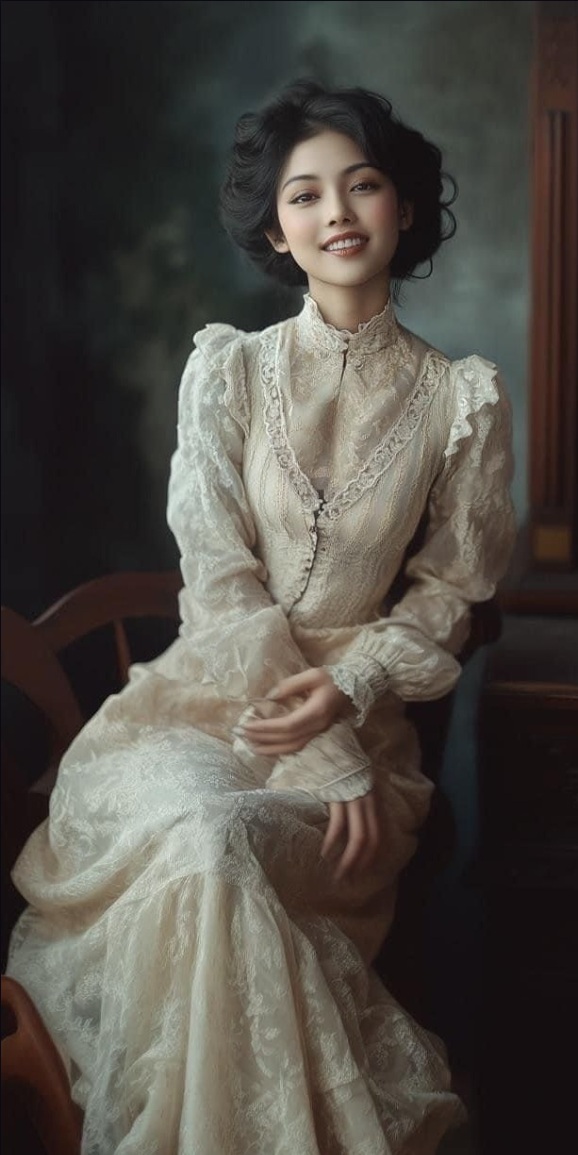
“Gideon, Inspector Clement—allow my to introduce Hana Hawthorne, my wife.”
To say I was taken aback is an understatement. Silas was married?!?
Much to my horror Clement was anything but surprised—his face lit up and his eyes fixed on Mrs Hawthorne. “A pleasure, Detective Chief Inspector Edmund Clement at your service,” he said, bowing slightly and kissing her hand! It had taken me months to earn that kiss and now he was bestowing it freely! And what is more, telling her his name?!
“Detective Chief Inspector,” Silas grinned, “Congratulations on your promotion, Clement.”
I spun to my so-called friend. “Silas! This is quite unacceptable—you have been married to the lovely Hana and never told me?”
“Ah yes, about that—”
“For how long have you been in wedlock, Silas?” I demanded.
“Well. Some five years?”
“FIVE YEARS!”
“Yes Gideon. It’s a long story, perhaps for another time?” he smiled wanly as Blackwood’s carriage arrived.
Well I never.
Blackwood had invited Salvin as his guest, who was obviously used to this kind of thing. After further introductions we were ushered inside, me clutching Clement’s arm as he did his best to tear his gaze from young Mrs Hawthorne. “Eyes forward, Edmund,” I hissed.
We were led into plain vestibule where uniformed servants provided us with vol-au-vents and sparkling champagne. I turned my attentions to young Hana Hawthorne, discovering she had been ‘hiding’ these last five years with her father. “And why were you hiding my dear?” I said through clenched teeth. Before she could answer Silas steered the conversation back to safer ground, but I could see there was yet another secret they were keeping from us.
After some time we were ushered into a beautiful long mahogany-floored hall. The walls held all manner of portraits and grand couches were scattered about. We stood awkwardly as the privy secretary somehow managed to wrangle us into a greeting line without having to say a word.
Moments later a door hidden in the wall panelling was pushed open.
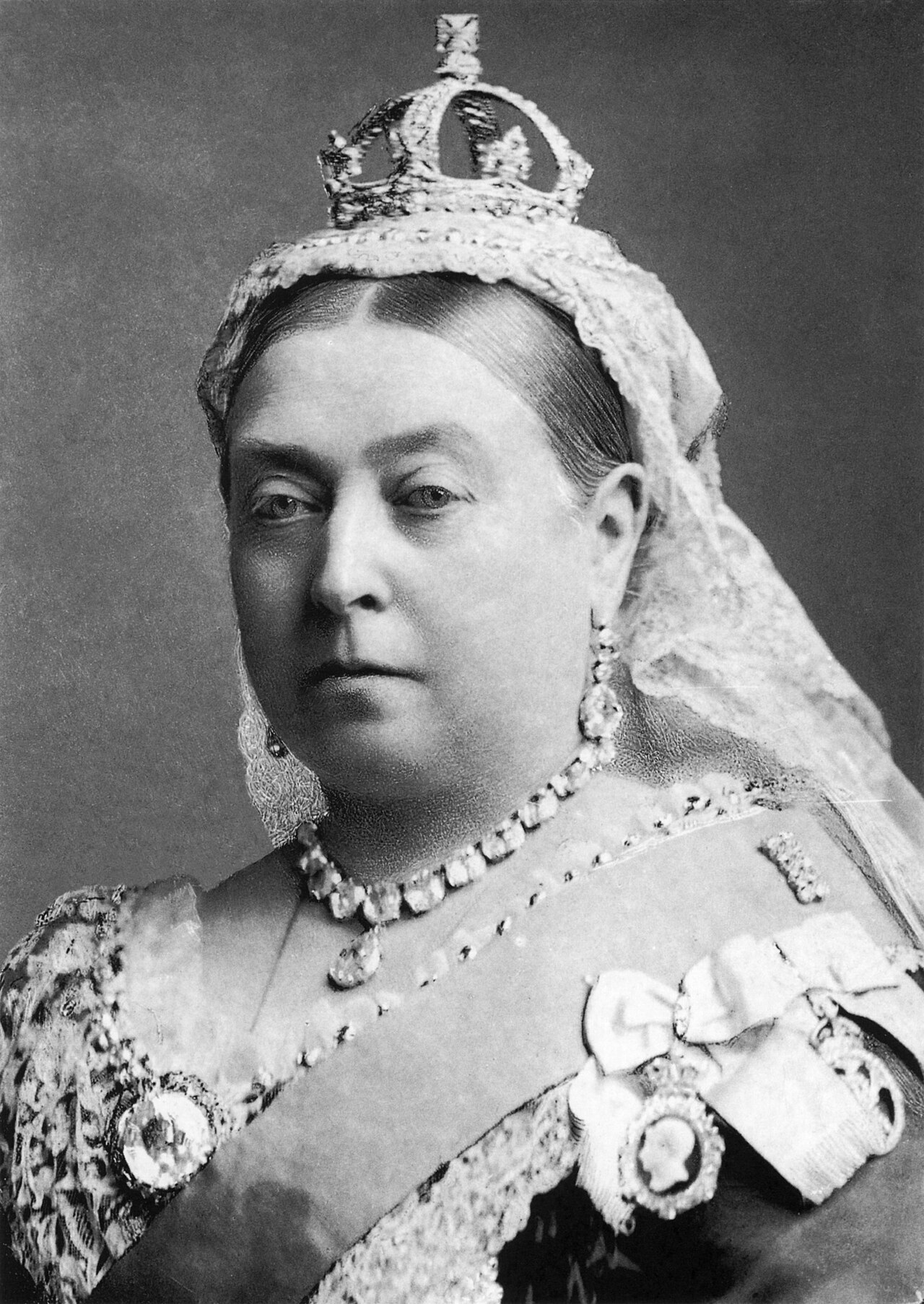
“Her Majesty Victoria, by the Grace of God, of the United Kingdom of Great Britain and Ireland Queen, Defender of the Faith, Empress of India,” the privy secretary announced with great gravity.
Victoria was as impressive as you might hope. I almost fainted.
“Mr Blackwood,” She intoned formally. “For your services to the Crown, the Royal Household, and the Crown Jewels, I present you with the Albert Medal.”
“Your Majesty,” Blackwood bowed deeply as a lackey pinned said medal to Blackwood’s proud chest.
“Mr Salvin,” the Queen nodded, then moved to stand in front of me.
I quaked.
“Miss Harrow.” (I did not correct Her). “For your services to the Crown, the Royal Household, and the Crown Jewels, I present you with the Albert Medal.”
I curtseyed, Clement’s strong arm the only thing keeping me upright.
“And you are?”
“DCI Clement of the Yard, ma’am,” Clement bowed.
I was pleased to The Queen seemed rather unimpressed as she moved on. “Doctor Hawthorne. For your services to the Crown, the Royal Household, and the Crown Jewels, I present you with the Albert Medal. And who is this?” She asked looking toward Mrs Hawthorne.
“Your Majesty, this is my wife Hana,” Silas announced.
Victoria Regina nodded once, turned, and exited.
I could finally breath. “Is that it?” I whispered.
“Well we’re still alive,” Silas joked and I could have slapped him!
“The Albert gold medal is the highest award granted to civilians,” Blackwood said with some awe examining his. “It is a great honour.”
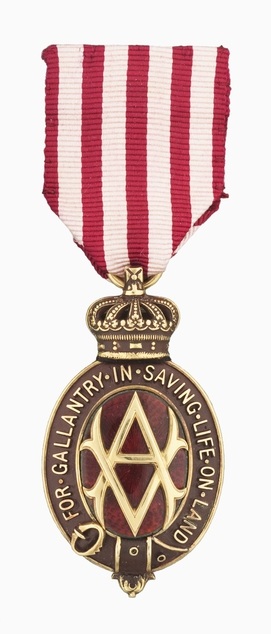
The Albert Medal
The Medal was a fine gold medallion with a red enamelled background, topped by a crown with the letters AV centred. Around the letters was inscribed: FOR GALLANTRY IN SAVING LIFE ON LAND.
Even I felt honoured.
As we departed Silas suggested we retire to the Coffee House to reflect on events. Clement had a better idea: “How about a French meal—I know just the place!”
We took his advice and were soon ensconced in a rather nice establishment—their vol-au-vents were rather better than our earlier fare. “I must say I am curious as to why we have been so honoured,” I said through a mouthful of a most delicious savoury éclair.
“Madam, if you will pardon me, but you did save the Crown Jewels, did you not?” the darling Hana said softly. Her accent was as attractive as she, a blend of learned English and cultured Japanese.
“Bravo! Well said, Mrs Hawthorne,” Clement beamed, “This was no small accomplishment!”
I rolled my eyes. “That’s all very well, but we were specifically advised that our presence ‘muddied the waters’, so does this not muddy them further?”
“I think you are overthinking this, Gideon,” Silas said. “My wife is correct: what we have achieved is extraordinary, but, as we know, we have enough supporters in high places to advance our claim to these fine medals. I still don’t know who the Member of the Commons is!”
‘My wife’. Pah. I barely heard anything Silas said, so dumfounded was I still by this new status of Silas.
Talk turned to the mirrors at some juncture and Blackwood turned to Clement. “Tell me DCI Clement, did you destroy all of the mirrors?”
“Indeed I did sir, every last one, and with some relish,” my erstwhile companion declared happily.
“A shame, keeping one or two might have been prudent.”
“Not a sausage I’m afraid!”
Clement maintained his singular focus on Mrs Hawthorne, and I was bitterly disappointed to see him sink further and further into drunkenness as the evening progressed. His charms were drastically reduced once be became a slobbering mess, and we farewelled on rather colder terms than we had met.
I haven’t seen him since, though not for his want of trying—Eunice tells me he has visited almost daily.
“The usual, Mr Clement?” Eunice reported asking.
“Is she in?”
“She’s not receiving anyone, Mr Clement.”
Eunice told me he looked increasingly crushed with each failure.
We shall see, Edmund, we shall see.